
With packaged foods there is no doubt as to what you are expected to pay (the selling price) and it is easy for you to check whether you have been charged the right amount by looking at the till receipt. However, in Britain today there are a number of practices that are unfriendly to the shopper and which may distort the market for retailers. To prevent you from getting muddled, we list some examples below.
Imperial pricing
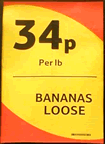
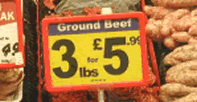
Imperial-only pricing for loose sold goods is not uncommon in the UK but prevents the consumer from comparing prices. When goods are offered loose at the greengrocer, butcher, fishmonger or delicatessen counter, by law they should be marked using a metric unit pricing.
 |
 |
Confused?
Or do you love to use a calculator to compare prices? |
 |
 |
|
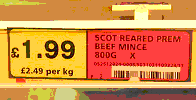
Thus some traders may mark prices in metric only, others in metric and imperial and some in imperial only. It is impossible to compare metric-only with imperial-only prices without a calculator!
If you are faced with dual metric/imperial pricing and only remember the imperial price, you immediately put yourself at a disadvantage, as you cannot check whether you have been charged the right amount at the checkout. If the shop assistant enters the wrong product code, you will be charged the wrong price and will not know it.
|
You cannot use the imperial price to check whether you have been charged correctly as the checkout is metric. | 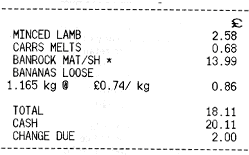 |
It is only possible for you to check the till receipt using the metric unit price.
While most shops fulfil the legal requirements for shelf labelling (metric unit price compulsory, optional supplementary imperial unit price), some advertise imperial prices prominently. This practice goes against the spirit of the Price Marking Order; the official regulation for labelling the prices of goods.
The risk for you is that you remember the prominently displayed imperial price and incorrectly compare it with a metric price. This can seriously mislead you.
Illegal imperial prices
The National Audit Office has identified inaccurate weights and measures as a significant problem in Britain. In 2000-2001 two million items were tested and 5% of measurement devices were failed.
Since 2000, only metric weighing and measuring equipment is legal in Britain. Equipment is only legal if it is of an approved type and has a mark or stamp to show that it is properly tested. Would you trust your purchases to illegal scales?
Too many ways to measure and price
In some cases, current regulations permit different ways of measuring food. For example, it is legal to sell prawns and shellfish by weight or by volume. This is bad news for the shopper who has no chance of being able to compare price by weight with price by volume.
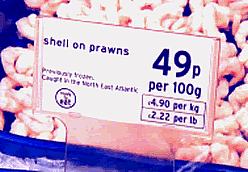 |
It is impractical to compare weight and volume prices for prawns. (Pints are also illegal for pricing seafood). |  |
Why it is hard to compare apples with apples!
A number of foods including onions, garlic, coconuts, lettuces and fruits, may be priced per item. This is not a problem if that is the only way that they are priced – as is the case with limes and coconuts.
With some fruit – especially apples and oranges – it is not uncommon to see three different ways of pricing in the same shop!
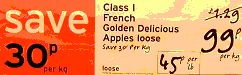 |
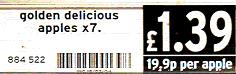 |
 |
|
How can you compare price per kilogram with price per apple and price per pack? All three are permitted.
Disclaimer
The examples of what UKMA views as consumer-unfriendly practices are real and representative of how food is sold in Britain today. The fact that certain examples have been used should not be taken to be singling out particular retailers for criticism. These practices are unfortunately widespread and are a direct result of a poorly executed transition from imperial to metric by successive governments. UKMA campaign for a reform of British price marking and advertising regulations to give consumers more transparent pricing.
 UK Metric Association