
Conversion Rationale and Lessons Learned
The following is an extract from the Final Annual Report (1980-1981) of the (Australian) Metric Conversion Board (MCB). This is re-produced with permission from National Standards Commission, Sydney, Australia.
In surveying the progress with our metrication from being a country which exhibited only isolated instances of metric usage in 1970, such as in Olympic sporting events and the size of photographic films, to a country which is over 90 per cent metricated in 1981, it is instructive to identify the key elements in the rationale adopted and main lessons learned. This was attempted in the 8th Annual Report (para 2.1. page 8) but has been revised in the light of three years further experience with the change.
The key elements were:
- unequivocal commitment to Australia’s conversion by Federal and State governments;
- the Federal Government’s decision was based on an all-party unanimous recommendation following a detailed inquiry by a Select Committee of the Senate, thereby providing the answer to the inevitable query “Why was the matter not put to a referendum?” and allowing the Board to get on with planning and facilitating change without having to defend the Government’s decision;
- the change was treated primarily as a technical one (which it is) and was almost wholly free from political disputation;
- general support for the decision by industry, commerce, organised labour, professional and trade associations and local governments;
- general acceptance that 10 years was an appropriate conversion period;
- an explicit statement in the Metric Conversion Act that the object of the change is ultimately to convert wholly to metric units, as is necessary if the benefits of the simplicity and coherence of the modern metric system (SI) are to accrue;
- the development of conversion plans for each sector of activity identified as in need of such a plan –
by appointing an MCB Sector Committee of national leaders nominated by the relevant organisations and drawn from all over Australia,
by encouraging each Sector Committee to develop a draft program by consensus on the basis, hopefully, of optimising the change and ensuring it has associated with it the available benefits such as rationalisations and other economies,
by critical assessment of proposed conversion plans by as many as possible of those likely to be directly or indirectly affected by them,
by reviewing all comments and giving wide publicity to the agreed plan and if considered appropriate, by including the plan in a brochure which provides other relevant conversion details;
- support for the voluntarily agreed plans in all possible ways, including mandatory provisions where appropriate through the amendment of legislation, technical standards and codes of practice and the commitment of large organisations to act as “front runners” in the implementation of conversion programmes;
- in the belief that a knowledge of the new system of measures would only come to the public through the experience of being exposed to the metric system and that the offer of instruction in the system or an attempt to provide such instruction through paid advertising would be largely wasted, the Board’s aim was to establish metric manifestations wherever possible and in association with these to provide assistance with their assimilation;
- learning by experience is hindered rather than helped by the use of equivalent metric – imperial quantity statements and accordingly dual statements were restricted to “need to know” situations; and
- effective communication is critical if fear of the unknown is to be allayed and intelligent cooperation obtained in the implementation of conversion plans.
Some lessons learned in giving effect to the above principles were:
- consensus planning presupposed effective and continuing representation of all significant interests. The enthusiasm engendered by involvement in metrication made this possible and resulted in very few indeed of the thousands of conclusions reached by the Board’s committees without vote, being challenged or upset;
- a sector program which has the support of national leaders will generally be accepted by their peers and will usually be implemented with goodwill in the spirit in which it was developed and so only needs to be in general terms with sufficient flexibility to take care of unforeseen contingencies;
- early conversion of technical standards, i.e. before the event, although contrary to the usual practice in developing a standard, was a most important element in many conversions;
- target dates (“M days”) for a key element of a conversion programme helped to marshal and coordinate support for the implementation of that programme;
- the optimum change was usually a quick one;
- changes should not be made the occasion to increase price rates or to make the relevant conditions more severe;
- while the concept of a wholly voluntary change may appear attractive, in a fiercely competitive situation this will engender confusion and disadvantage both to traders and customers by prolonging unduly the period during which imperial and metric units are used. In such cases a mandatory change, after suitable preparation, resulted in orderly trading almost overnight to the satisfaction of all;
- resistance to the metric change is mostly due to fear of the unknown. Few realised it could be a simple, non-traumatic experience so that, with the general public, support for the change can only be expected after it.
M-days
Setting a target date, or M-day, for a key element of a sector’s metric conversion programme helped to coordinate support for its implementation. Each M-day was accompanied by an intensive public education campaign. Pamphlets and other information material were issued, and newspapers, radio and television all cooperated in explaining the new units, and how they would affect the public.
1 September 1972 – Weather
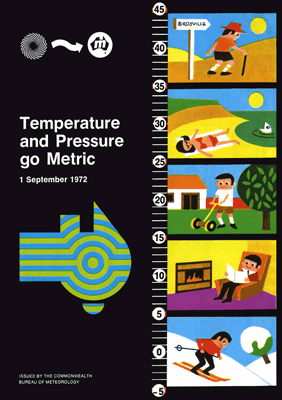
“Temperature reports in public advices issued by the Bureau of Meteorology, Australia’s official weather service, will be only in degrees Celsius from September 1.
…
The Bureau does not favour a dual system of publication because overseas experience has revealed that this makes it harder for people to adapt to the new unit.Some news media may wish to use a dual system for a limited time period, but it is expected this will be discontinued from September 1.
If temperature were expressed in both units every day, the public would find it difficult to learn Celsius.”
1 July 1974 – Motoring
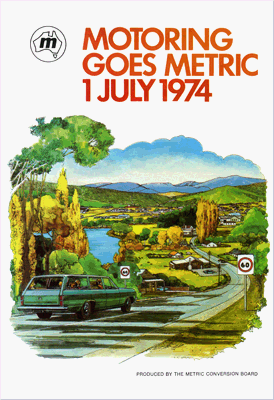
“When?
From 1 July 1974 speed and distance signs will be in metric units.What?
Distances will be measured in metres (m) and kilometres (km) and speed in kilometres per hour (km/h).”
 UK Metric Association